The pharmaceutical industry has unique regulatory guidelines that make any changes to operational processes challenging to realize.
Even so, pharmaceuticals have been bold in setting aggressive energy and emissions goals and commitments. AstraZeneca, for example, has set their ‘Ambition Zero Carbon’ program, where they commit to have zero carbon emissions from operations across the world by 2025, and have projected their entire value chain to be carbon negative by 2030.
Fortunately, pharmaceuticals can implement heat recovery strategies that will make impactful steps towards increasing industrial energy efficiency without changing their operations. Because no operational changes are needed, dealing directly with their waste heat presents both the easiest and most impactful way for pharmaceuticals to make these strides.
Pharmaceuticals typically use the following three energy processes:
- Heating
- Cooling
- Drying
Each of these applications present an opportunity for facilities to capture and repurpose waste heat energy to improve industrial efficiency and lower carbon emissions.
Use A Condenser Economizer To Capture Waste Heat From Boilers
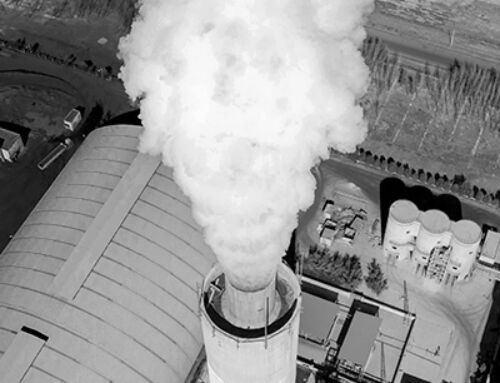
In pharmaceuticals, steam for manufacturing processes is largely generated by natural gas boilers. The thermal efficiency of boilers is about 85%, meaning that roughly 15% of the initial energy input is lost as waste heat. Since burning natural gas — which is largely methane (CH4) — produces a lot of water vapor, much of this waste heat is steam that rises into the atmosphere as untapped potential.
Implementing a condenser economizer will capture the potential from this otherwise wasted steam. To do this, a condenser economizer cools the steam to extract both sensible heat and latent energy from the moisture. This recovered energy can then be repurposed for functions such as preheating process chemicals or preheating water and chemicals needed for sterilization.
It’s estimated that burning a pound of methane results in 2.25 pounds of water vapor. So in addition to recovering the latent energy from moisture, the condenser economizer also provides the benefit of recovering and conserving water. Capturing both latent energy and water, a condenser economizer reduces the water load and energy intensity of pharmaceutical industrials.
Apply Chiller Heat Recovery To Cooling Operations
Pharmaceuticals have to refrigerate many materials. Since energy can neither be created nor destroyed, the heat a refrigeration system removes from one area must be released to another – so the cold side of the refrigerator is matched by a hot side. When refrigerator exhaust heat is released and lost to the atmosphere, it is another source of waste heat. With chiller heat recovery, that exhaust heat can be collected and used for a variety of heating tasks in the plant.
Implement Dryer Heat Recovery To Drying Operations
Pharmaceuticals need drying operations to remove moisture from solid material and produce the final product. The most prevalent method is with a spray dryer, which blows hot air through a suspension to get a dry powder. After removing the moisture from the solid substance, this hot air exhaust is released to the environment as waste heat.
Similar to the chiller heat recovery, dryer heat recovery (or exhaust heat recovery) captures and reapplies the heat from the exhaust. It is sensible to use the recovered heat for operations in close proximity, so this heat can be thoughtfully repurposed to preheat the hot air used by the dryer, effectively reducing the amount of energy input needed to fuel the industrial furnace producing the hot air.
Managing Waste Heat Is The Easiest Way For Pharmaceuticals To Start Energy Efficiency
Carbon emissions from industrial process heat are typically considered hard-to-abate for two main reasons: (1) projects are financially unattractive and (2) additional technology development is needed.
As a vertically integrated Energy-as-a-Service (EaaS) and proprietary technology company, Skyven works with manufacturers to remove these barriers, successfully reducing costs for industrial process heat and moving the needle on industrial resiliency.
We recently demonstrated the impact of public-private project financing for America’s industrial sector by implementing six thermal energy projects at California Dairies, Inc. (CDI). In total, these projects have enabled more than 3,500 metric tons of CO2 reduction over the past year, and required zero capital expense from CDI.
Financing for these projects combined direct financing from Skyven, third-party financing from Kyotherm, and public funding from the California Energy Commission’s (CEC) Food Production Investment Program (FPIP). This approach, built on our unique EaaS model, enables industrial manufacturers to make progress on their energy goals without spending any money.
To access public funding, we help manufacturers identify, prepare, and submit applications to state and federal funding opportunities, such as the CEC funding used for these projects. Our end-to-end project execution includes management of these grant funds.
Under our EaaS model, emissions-free heat is delivered by our systems, like our Arcturus line of steam-generating heat pumps, and then measured and verified with meters and IoT data monitoring. The manufacturing facility pays for the delivered heat at prices lower than their current natural gas costs. These savings are then shared by the manufacturer, third party financers, and Skyven for the life of the contract.
The combination of third-party financing, public funding, and deployable technology leads to profitable industrial heat generation for everyone involved.
Efforts
Without changing operational processes, these techniques serve as low-hanging fruit for pharmaceuticals to reduce their energy intensity and deliver on their energy goals. In addition to reducing carbon emissions, improving industrial efficiency through waste heat management will also save pharmaceuticals money on process steam and fuel costs.
These efforts don’t need to be difficult or daunting. For pharmaceuticals, identifying opportunity to recover waste heat from heating, cooling, and drying processes is a stellar starting point. Pharmaceuticals that implement these heat recovery techniques will improve their industrial efficiency, and by doing so, they will also gain a competitive edge by reducing costs and freeing up capital for impactful top-line growth.